
Project Statement
In 2023, the Mellon Foundation, through its Monuments Project initiative, awarded Denver Parks & Recreation (DPR) and Denver Arts & Venues (DAV) a $2.3 million grant to assess Civic Center Park’s monuments and commemorative spaces. The grant supports two projects. This project, led by Denver Art & Venues, is a research and community engagement initiative designed to ensure that Civic Center’s monuments more fully reflect both the park’s historic and modern contexts. Its focus will be the 13 Civic Center monuments under DAV’s care, including In Honor of Christopher Columbus and the Kit Carson statue atop Pioneer Monument, both of which were removed in 2020 in response to controversy over their subjects.
For more information about this project, scroll to the FAQ section below. Information on the project led by DPR, which advances the Civic Center Next 100 initiative and honors Denver’s disability rights movement, can be found here.
Project
FAQs
-
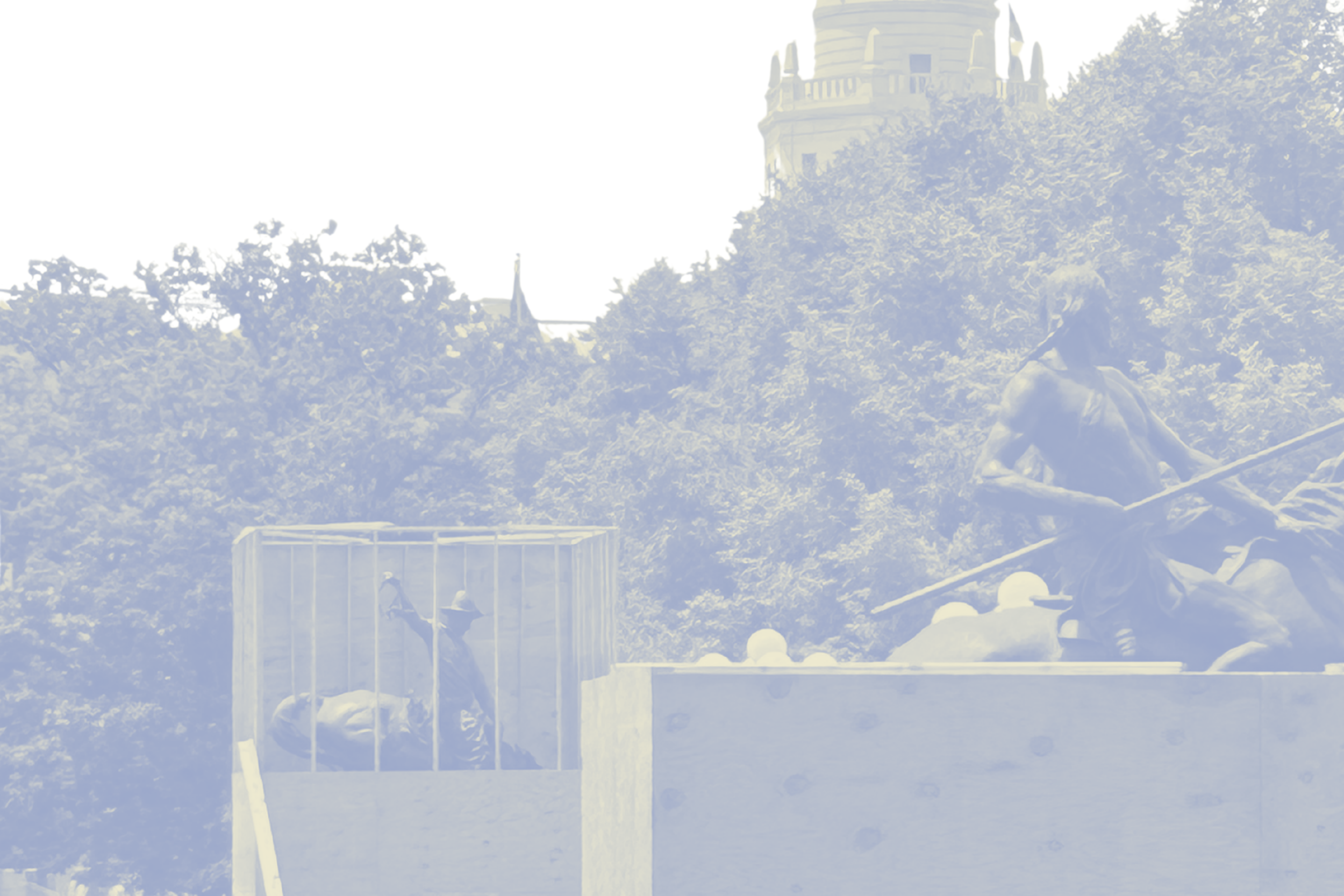
In June 2020, former Mayor Michael B. Hancock appointed a Renaming Commission, constituted by the Agency for Human Rights and Community Partnerships (HRCP) Advisory Board, historians, City Council members, and other local leaders, to review the names of every city asset, including city-owned properties, parks, buildings, and landmarks. This Commission was tasked with recommending which city assets should be considered for renaming (in particular, those associated with racist groups or ideologies), which should be reframed based on their histories, and which should remain unchanged. Concurrently, Denver Arts & Venues (DAV) was reviewing the city’s Public Art Collection, initially focusing on artworks within the City and County of Denver’s Civic Center Park and surrounding area. The pieces under review included the sculpture currently titled In Honor of Christopher Columbus and the sculpture atop Pioneer Monument representing the American frontiersman known as Kit Carson — both of which were removed from public view in 2020 in response to controversy around their histories and legacies.
In May 2023, DAV received a grant from the Mellon Foundation’s Monuments Project to further explore the monuments and commemorative spaces of Civic Center Park, through a deep dive into the history of the park and each work of art within it (Phase I) and a community engagement process (Phase II). The engagement phase of this project will feature small group conversations, workshops for artistic co-creation, and other opportunities to discuss the removed sculptures, stories and places of significance, and the future of Denver’s commemorative spaces, among other topics. It will culminate in a community event at which all findings and products from the process are presented and further discussed. -
This project is being funded through a $2.3 million Mellon Foundation grant.
-
Outcomes for the engagement phase of the Civic Center monuments project will continue to evolve
throughout the process as community feedback is received. Some anticipated outcomes include
recommended dispositions for the two statues now in storage, policies and procedures for addressing other potentially problematic artworks, and next steps for Denver’s commemorative landscape. -
Phase I of this project is complete. During this phase, researchers Anya Pantuyeva, M.A. and William Wagner, Ph.D. produced a report titled Denver Civic Center Monuments: A Historical Analysis of Public Art and Commemoration (2026) that analyzes artworks and structures in Civic Center Park to understand their creation, funding, themes, and roles in shaping the park’s public memory. This material was designed to orient and inform the Phase II community engagement process.
Phase II launched in April 2026 and will continue for approximately one year from that time.
-
Denver Arts & Venues is managing the monument audit and community engagement process around Civic Center’s commemorative landscape. National arts and culture planning firm Designing Local was hired to design and implement the community engagement process, while the audit was undertaken by researchers Anya Pantuyeva, M.A. and William Wagner, Ph.D.
-
One outcome of this process will be a series of updated policies and procedures the City and County of Denver can employ when assessing pieces in the current collection to ensure that all reflect broadly held community values. The process may further lead to the identification of themes or stories for Denver to consider as it commissions or otherwise acquires new public art in Civic Center Park. Additional outcomes for the collection may include a final disposition plan for the two works currently in storage, a proposed future intention for the empty pedestal on the Pioneer Monument, and the identification of ways to better contextualize other artworks in Civic Center.
-
This project contributes to a national — and international — conversation that has been ongoing since monuments were first installed centuries ago. What gets commemorated in public space? Who gets to tell these stories? What should happen when a monument no longer reflects widespread community values? Over the past 15 or so years, these questions have again risen to prominence within the United States, largely in response to violence against people of color that has sparked protest and the removal of statues honoring the Confederacy, Christopher Columbus, and other problematic subjects nationwide. Since 2020, the Mellon Foundation’s Monuments Project has funded projects in this space, with the goal of making the stories told in America’s public spaces more complete and accurate. A vibrant community of arts and culture practitioners, academics, and others is now working to tell new stories through public art, alongside efforts to remove pieces stemming from racism, colonialism, discrimination, and/or the celebration of problematic figures and historical moments. As a place with a complex history of Indigenous land being taken over by miners and other pioneers, Denver has a unique perspective to share within this conversation. Through this project we hope to identify new ways for public commemoration to tell the Rocky Mountain region’s layered, unacknowledged, and sometimes difficult histories.